Track 06 / 08 · 2025
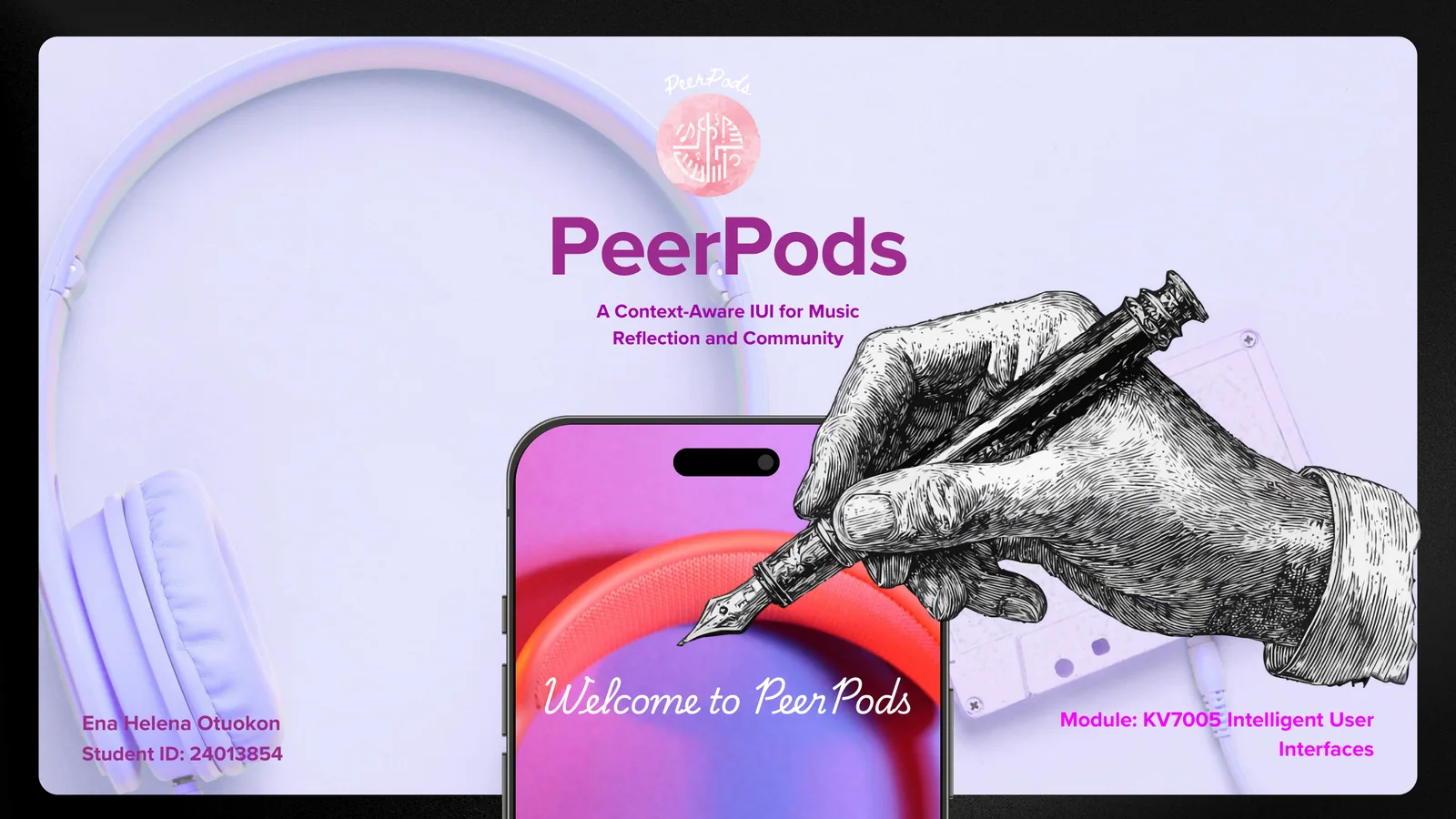
PeerPods
Product Definition · User Research · MSc AI
An AI-powered music community product, taken from user needs to an evaluated prototype.
The story
A context-aware product for music reflection and community. I found user needs through social listening on X, benchmarked 6 competing platforms, and built 3 personas and a requirements traceability map.
From there I took it from lo-fi wireframes to a hi-fi Figma prototype, tested in think-aloud sessions with 3 participants.
The AI features include adaptive writing prompts, context-aware feed re-weighting, an onboarding-driven recommender, and personalisation signals the user controls.
3 personas · 6 platforms benchmarked
Liner notes
Step by step
- 01
PeerPods
A context-aware intelligent user interface for music reflection and community, designed as a calm companion layer alongside existing music platforms for writing, discovery and peer connection.
 02
Problem statement
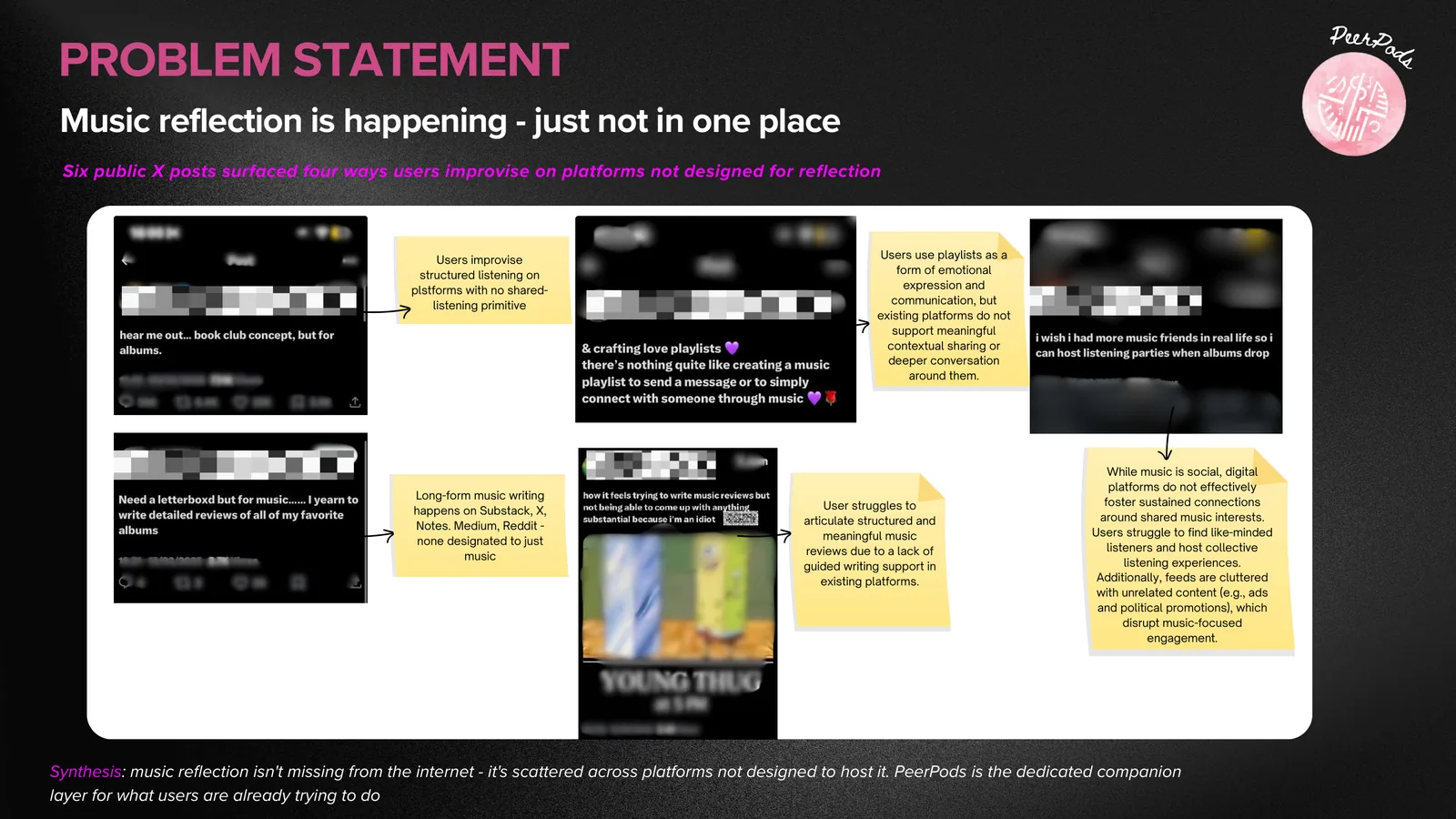
Music reflection is already happening on Substack, Reddit, X and Medium, but scattered across platforms not built for it. Six public X posts surfaced four recurring needs: structured listening, long-form review spaces, contextual playlist sharing and like-minded community.
 03
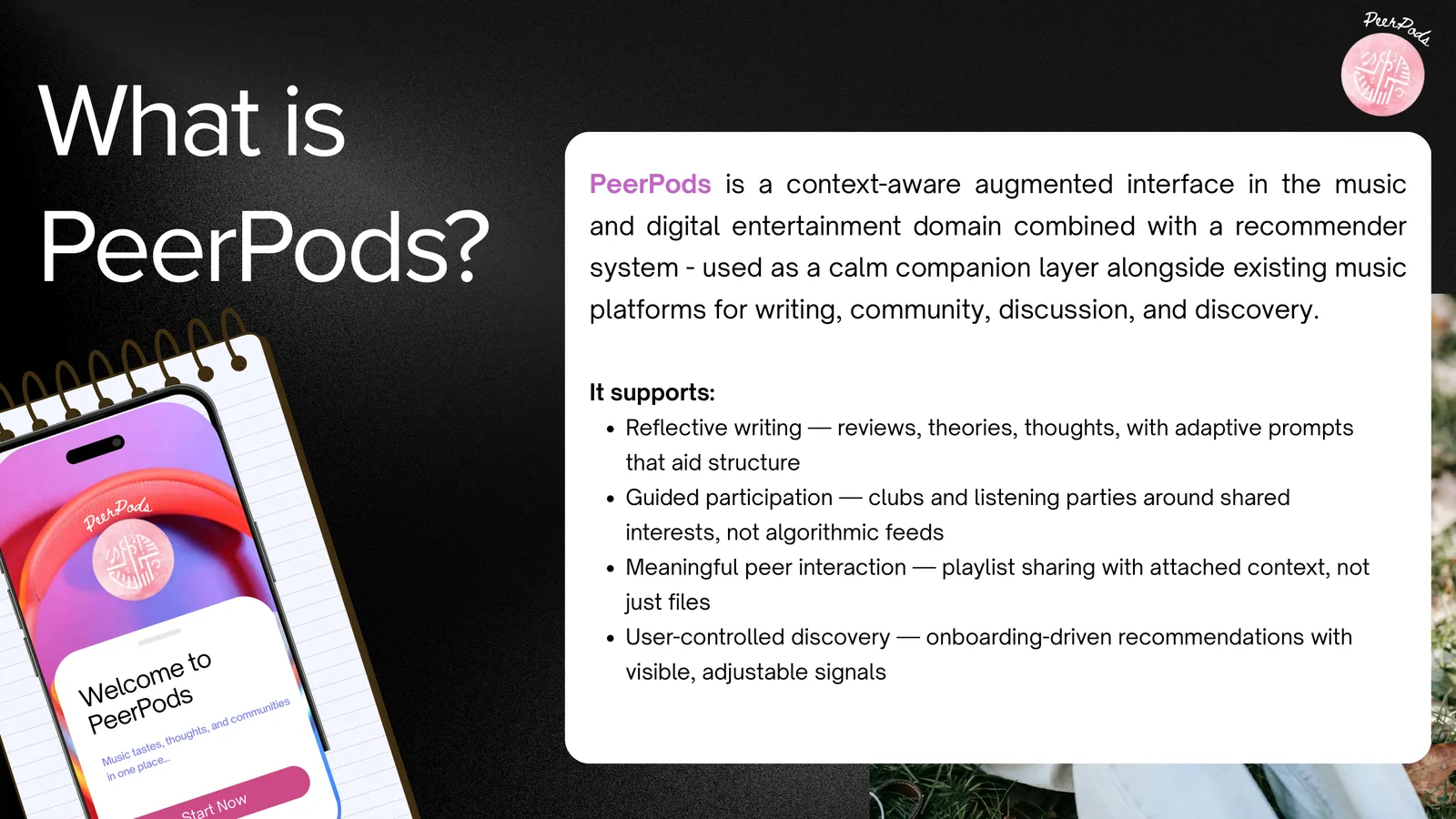
What is PeerPods?
Reflective writing with adaptive prompts, guided listening parties and clubs, playlist sharing with context, and onboarding-driven recommendations with visible, adjustable signals.
 04
Intelligence
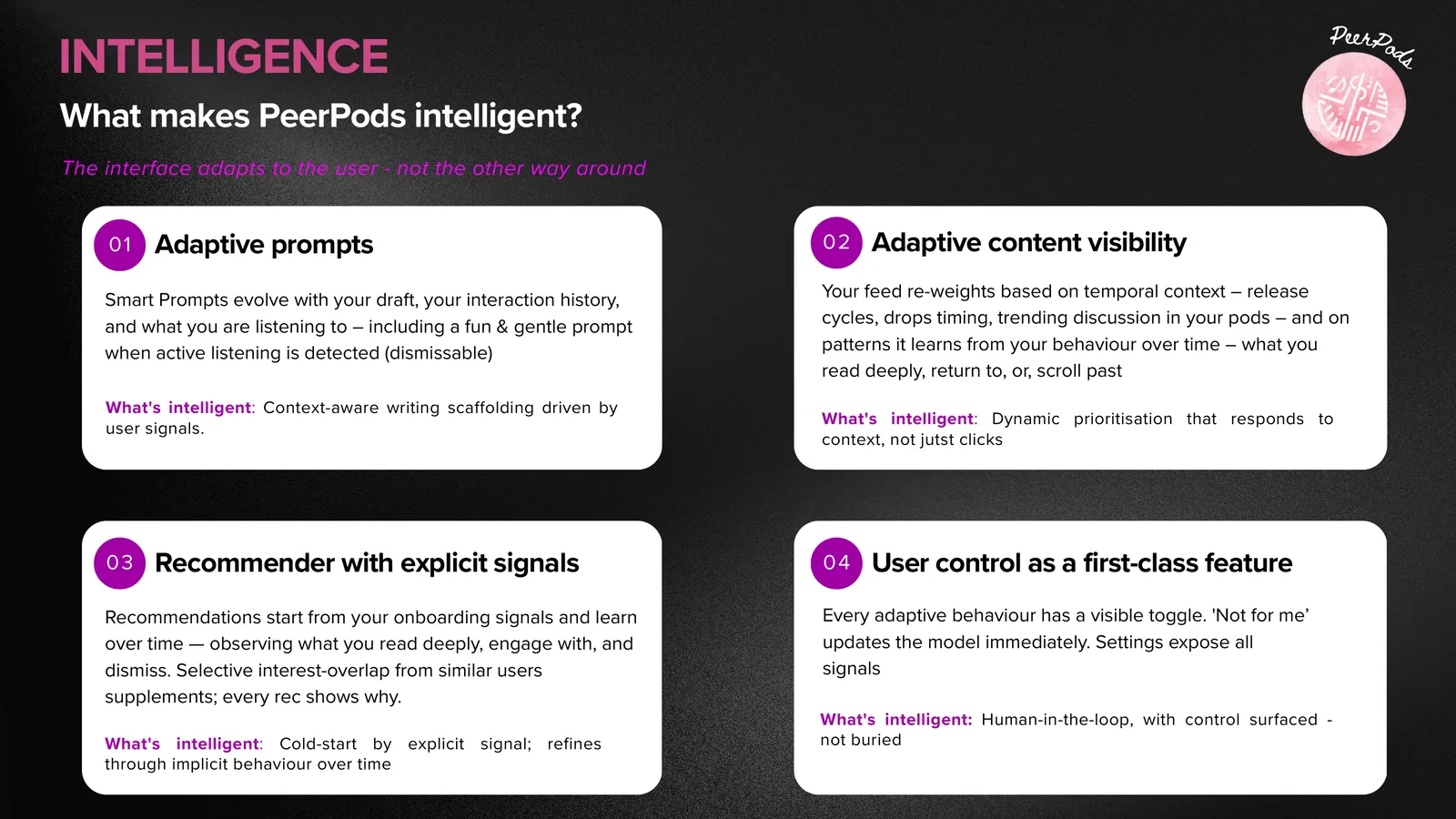
Four intelligent behaviours: adaptive writing prompts that evolve with the draft and listening history; content visibility that adapts to release cycles and reading behaviour; a recommender with explicit onboarding signals; and user control as a first-class feature, with every toggle visible.
 05
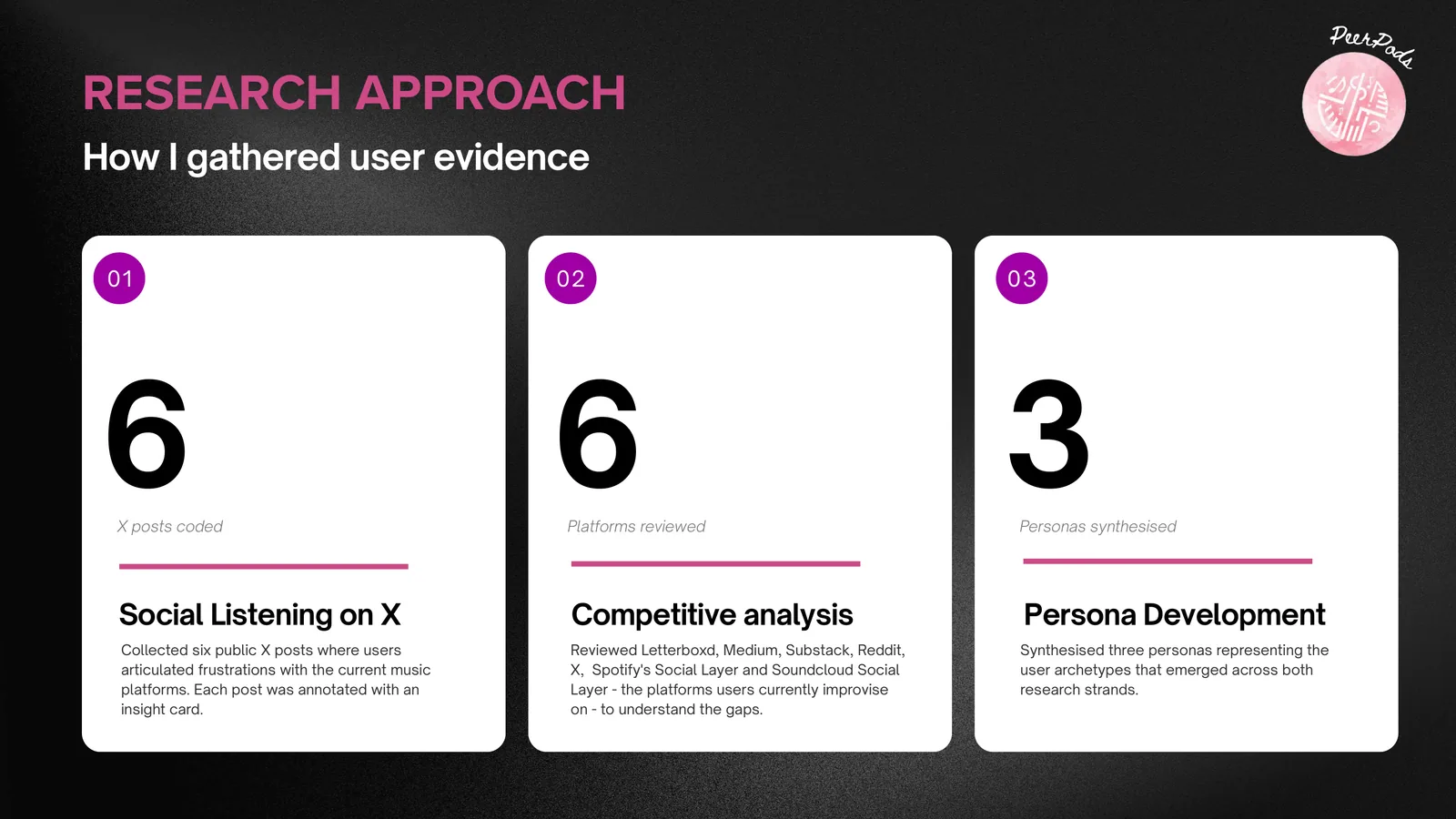
Research approach
Three strands: social listening on X (6 posts coded), competitive analysis across 6 platforms (Letterboxd, Medium, Substack, Reddit, Spotify, SoundCloud), and synthesis into 3 personas.
 06
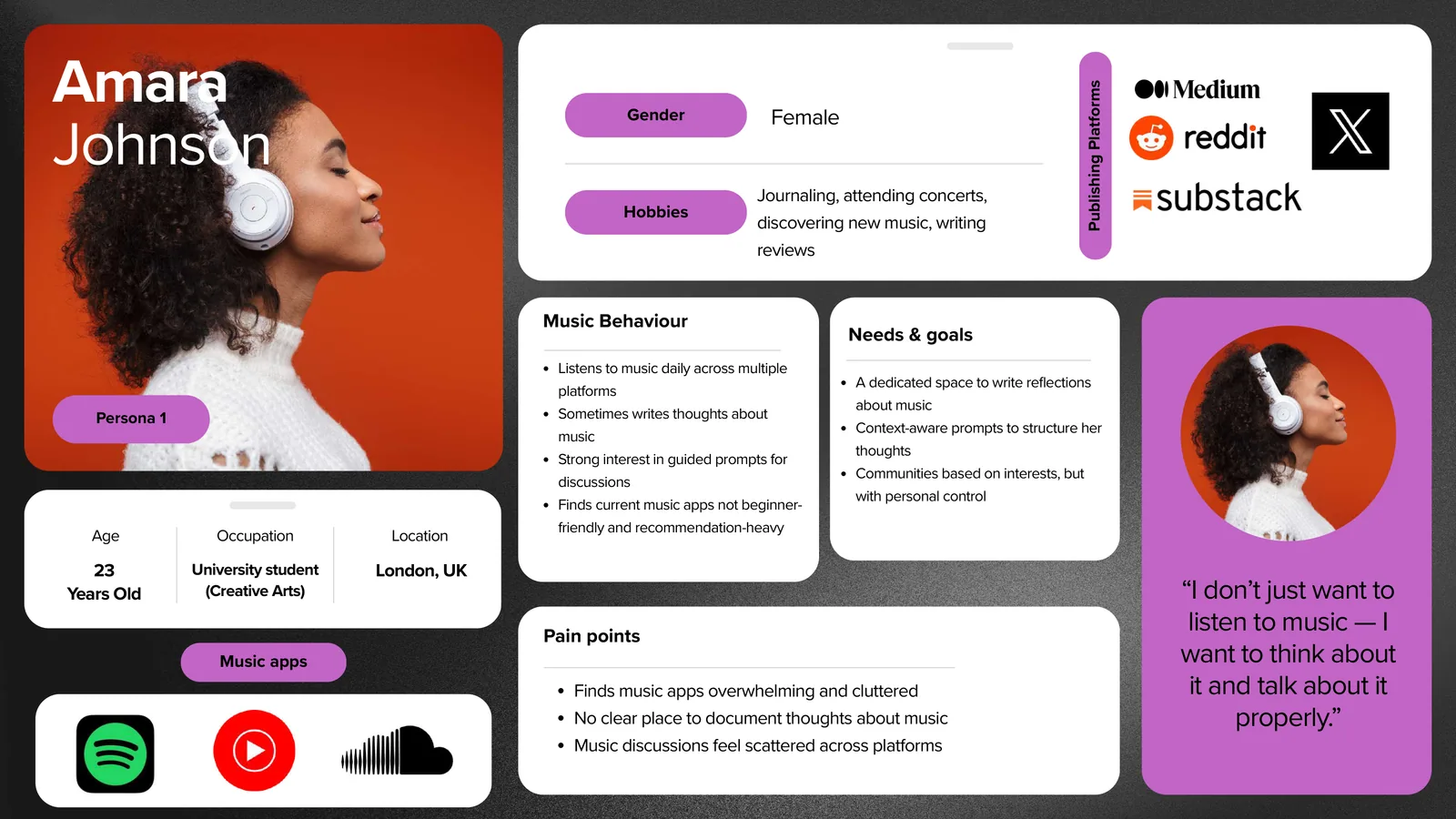
Persona 1: Amara Johnson
Amara, 23, is a Creative Arts student in London. She listens daily and sometimes writes about music, but finds apps overwhelming. She needs a dedicated space for reflections, context-aware prompts and interest-based communities she controls.
 07
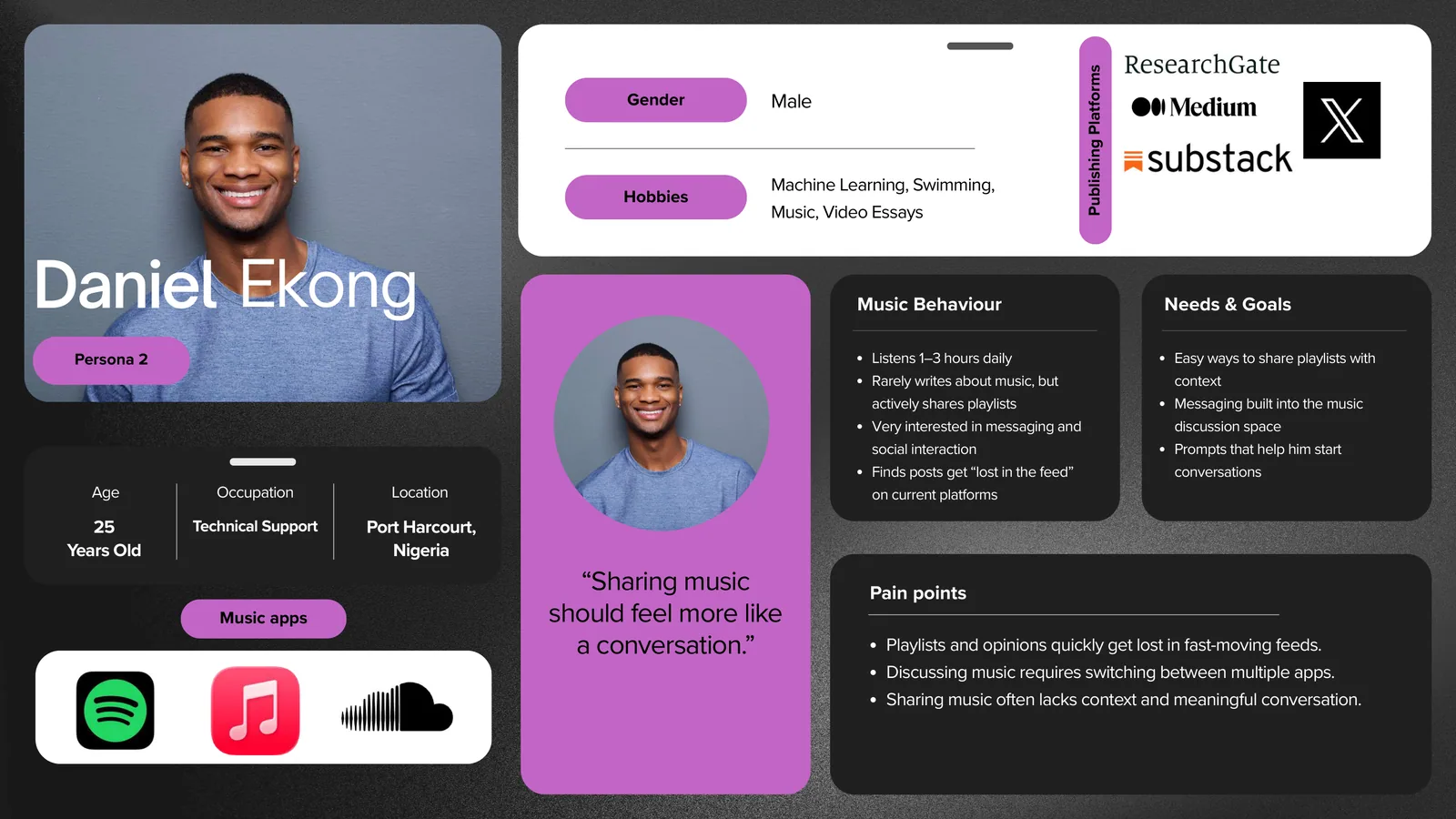
Persona 2: Daniel Ekong
Daniel, 25, works in technical support in Port Harcourt. He shares playlists actively, but his posts get lost in fast-moving feeds. He needs playlist sharing with context and messaging built into the music discussion.
 08
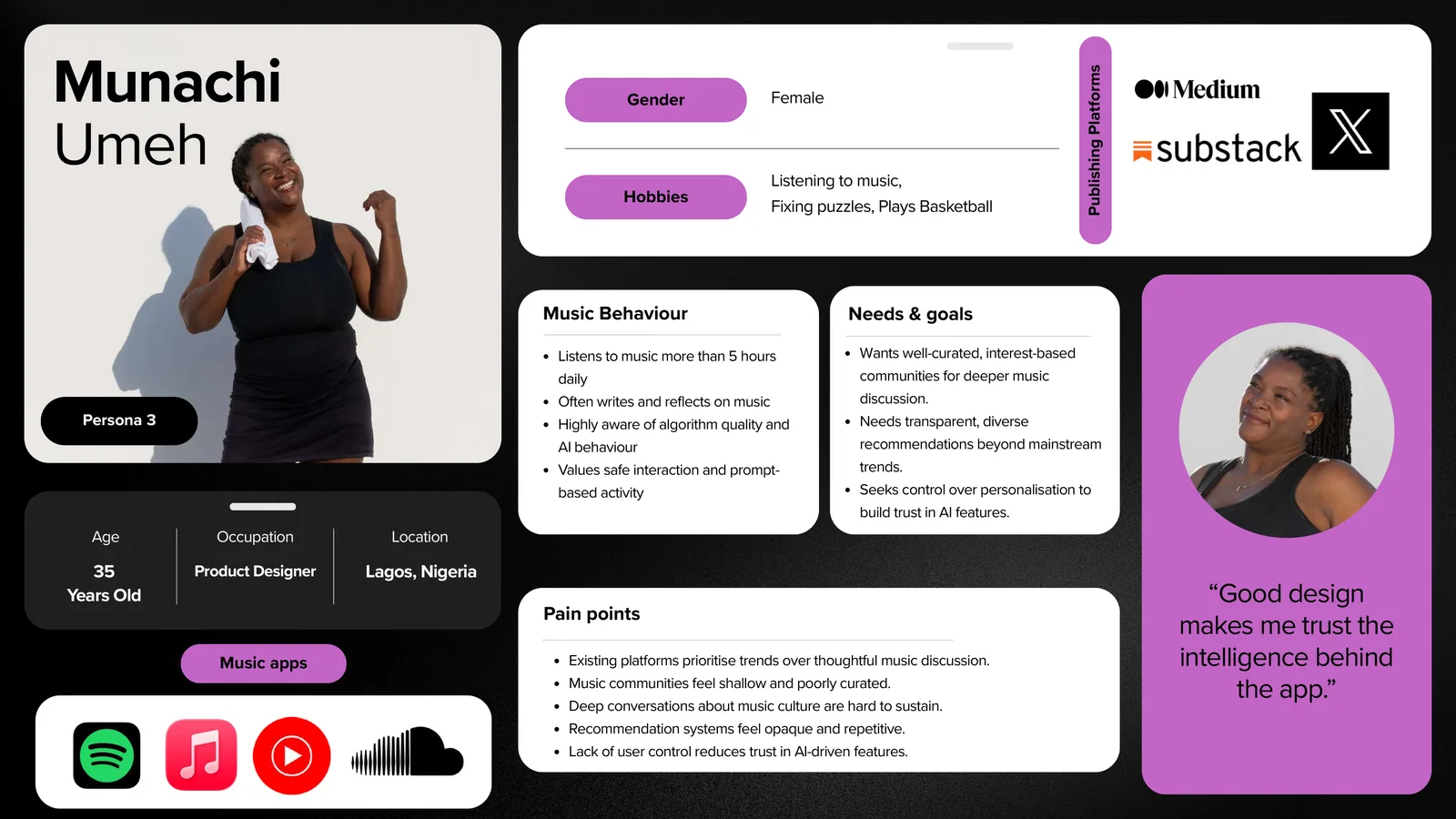
Persona 3: Munachi Umeh
Munachi, 35, is a Product Designer in Lagos. She listens 5+ hours a day and is highly aware of AI behaviour. She wants transparent, diverse recommendations beyond mainstream trends, and control over personalisation before she trusts it.
 09
Requirements
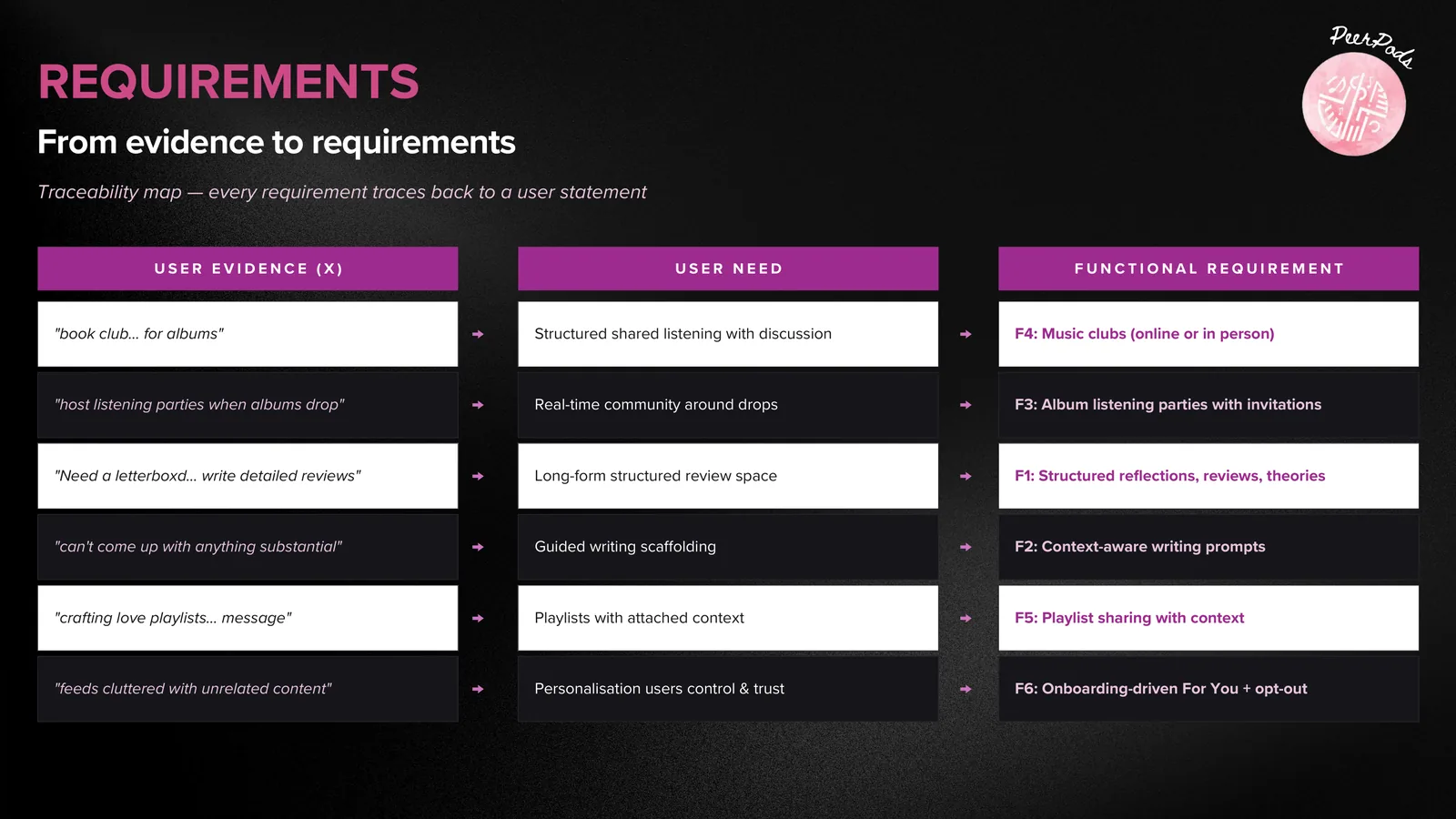
Every functional requirement traces to a user statement: F1 structured reflections, F2 context-aware writing prompts, F3 listening parties, F4 music clubs, F5 playlist sharing with context, F6 onboarding-driven For You with opt-out. No feature without evidence.
 10
Primary scenario: Amara
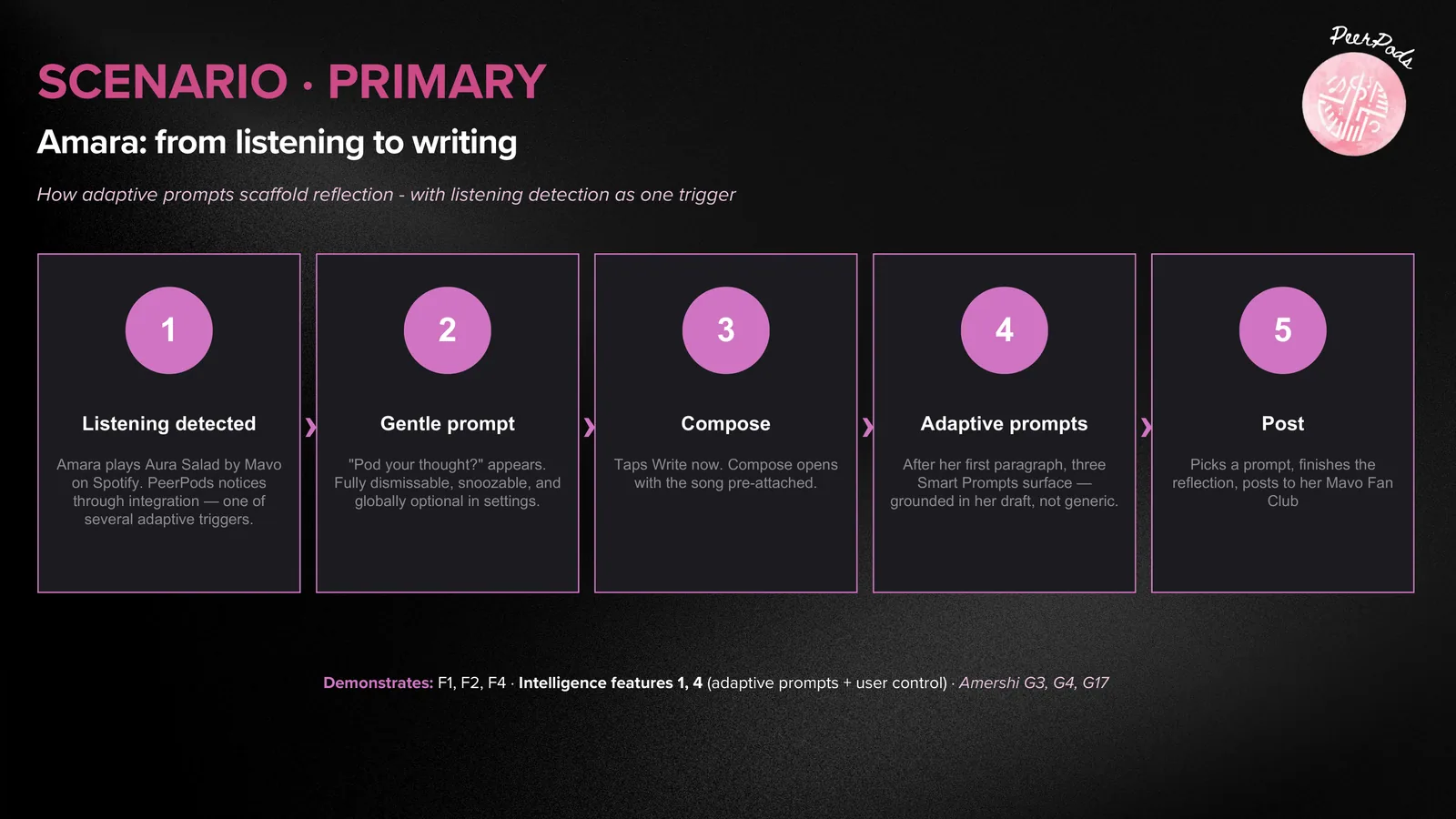
Amara plays a track on Spotify. PeerPods detects it and offers a dismissable prompt, "Pod your thought?" She taps Write now, the song attaches, she drafts a paragraph, and Smart Prompts appear, grounded in her draft. She posts to her fan club.
 11
Lo-fi wireframes
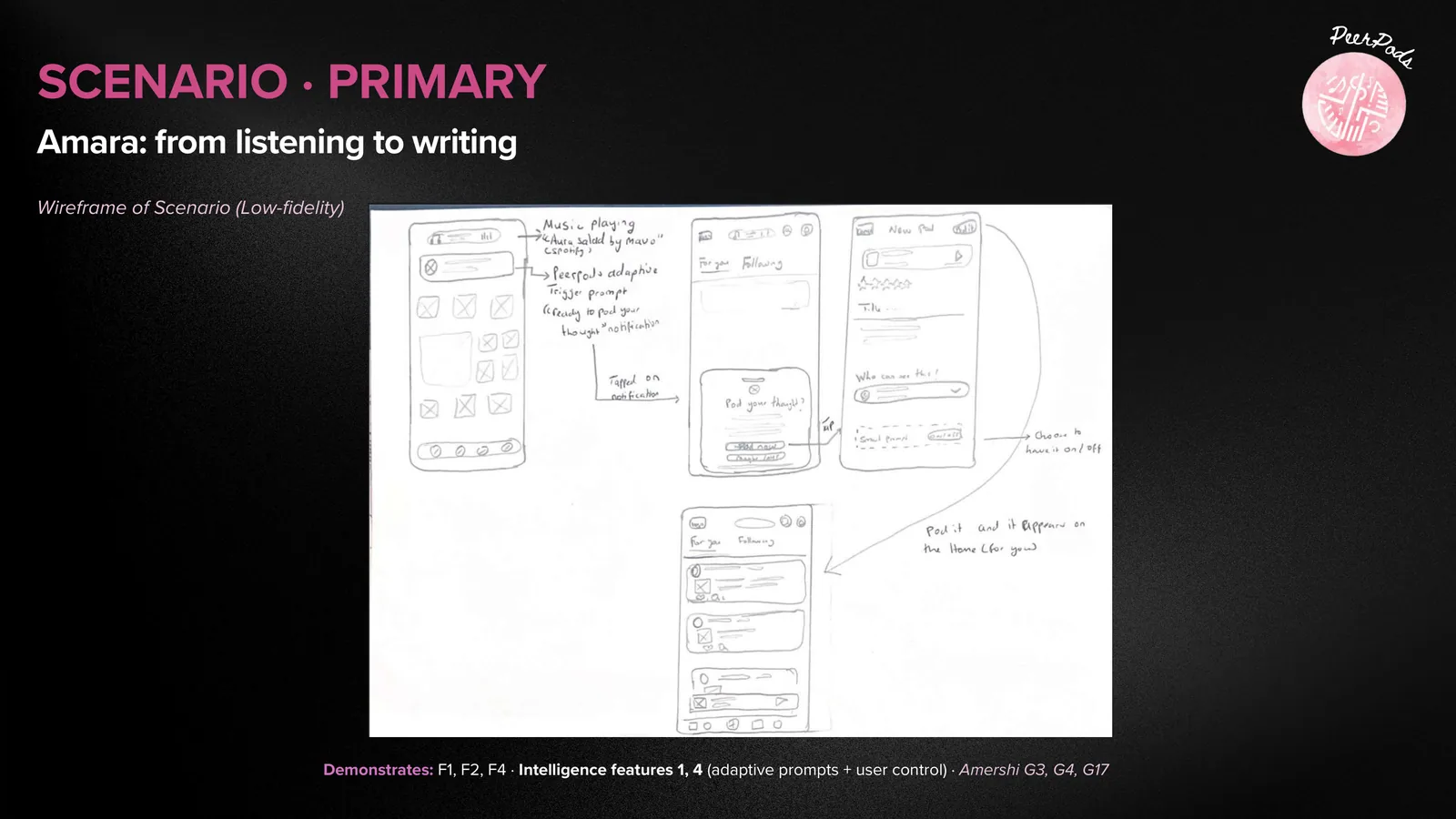
Listening detection triggers a gentle notification; tapping opens compose with the track attached; Smart Prompts appear after the first paragraph with an on/off toggle; the finished pod lands in the For You feed.
 12
Breadth scenarios
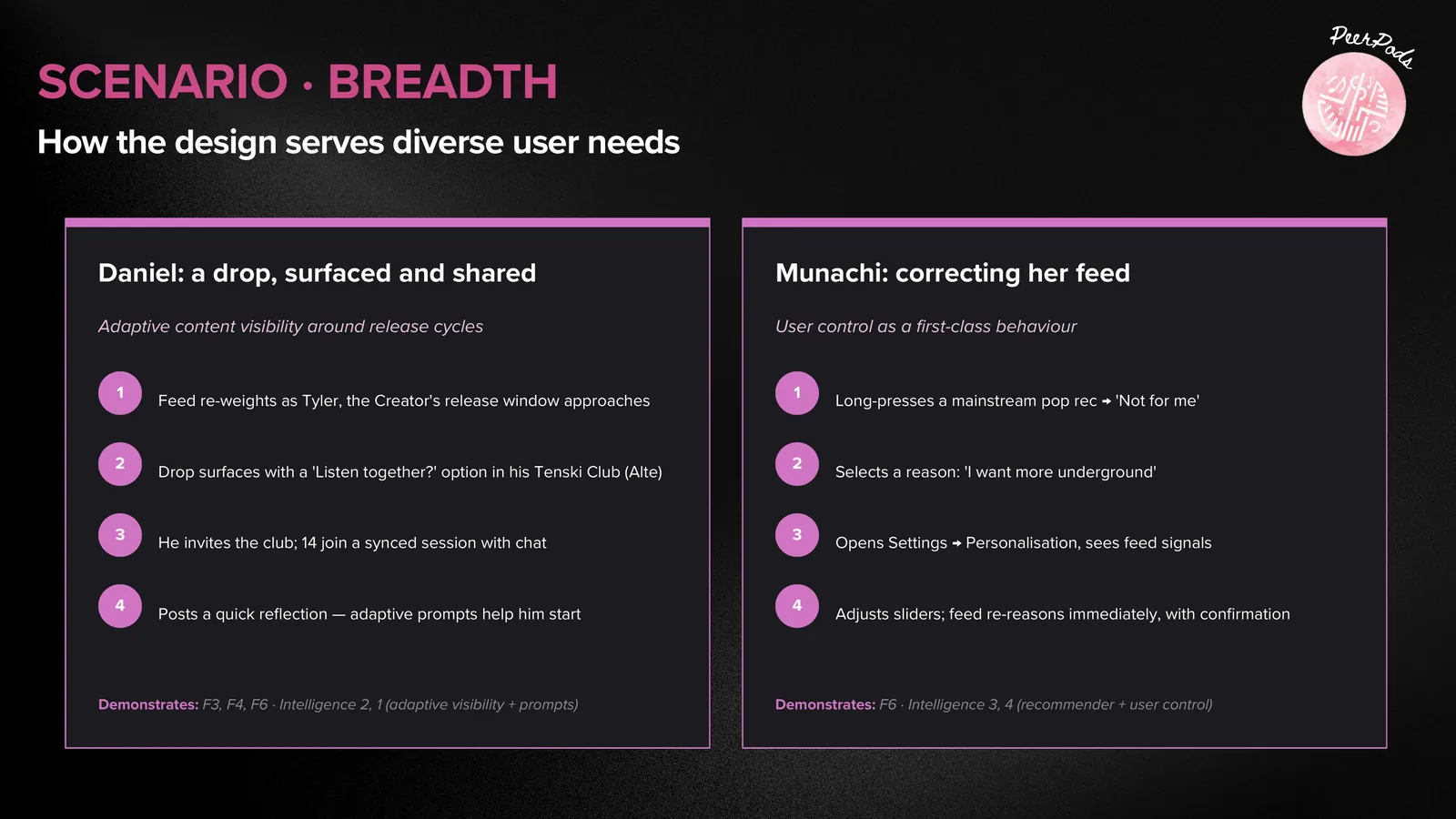
Daniel's feed re-weights as a Tyler, the Creator drop approaches and 14 members join a synced Listen Together session. Munachi long-presses a mainstream rec, asks for more underground, adjusts her feed sliders, and the feed re-reasons immediately.
 13
Information architecture
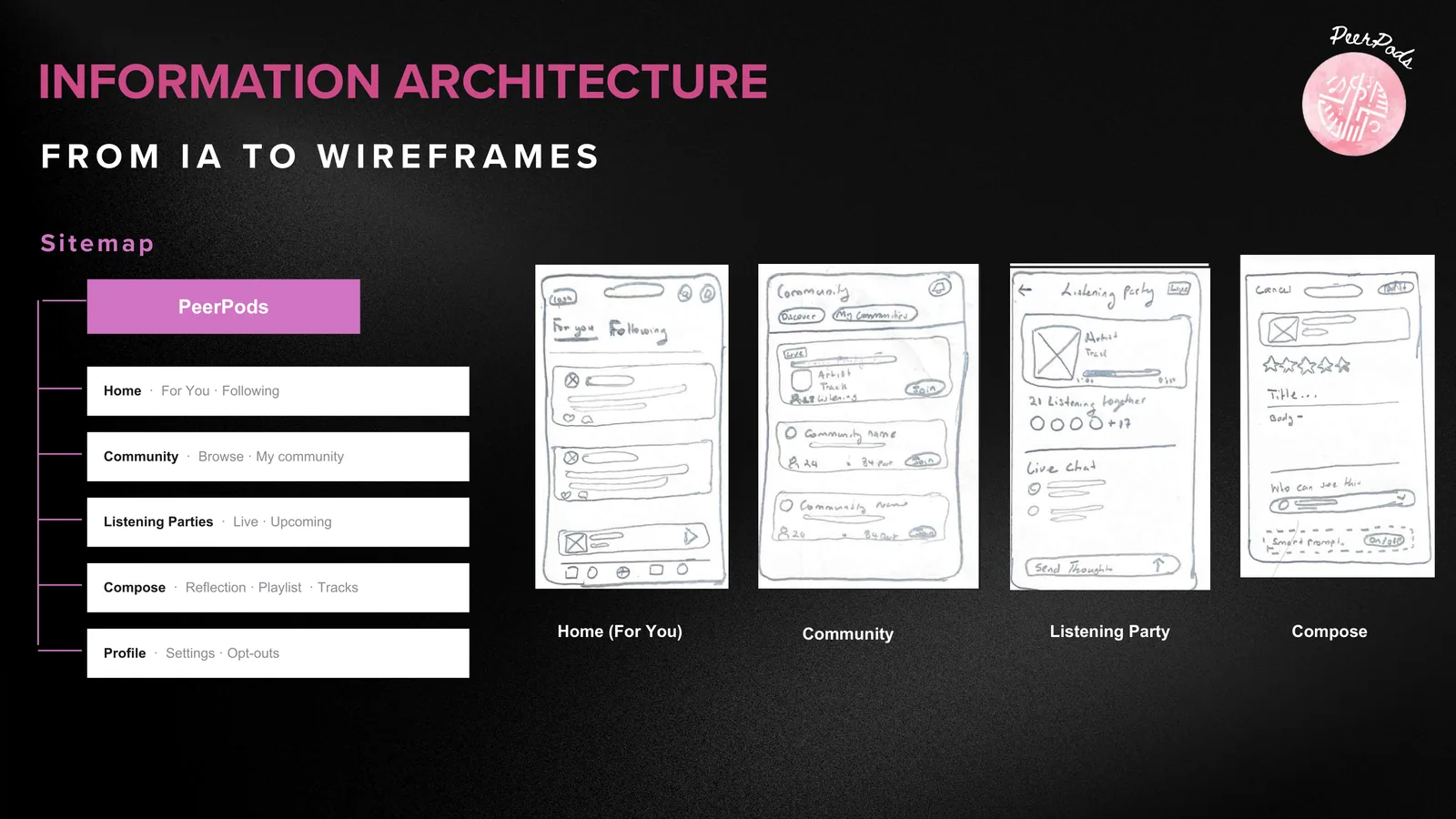
Five top-level sections: Home (For You / Following), Community, Listening Parties (Live / Upcoming), Compose (Reflection / Playlist / Tracks) and Profile (Settings / Opt-outs).
 14
Hi-fi prototype
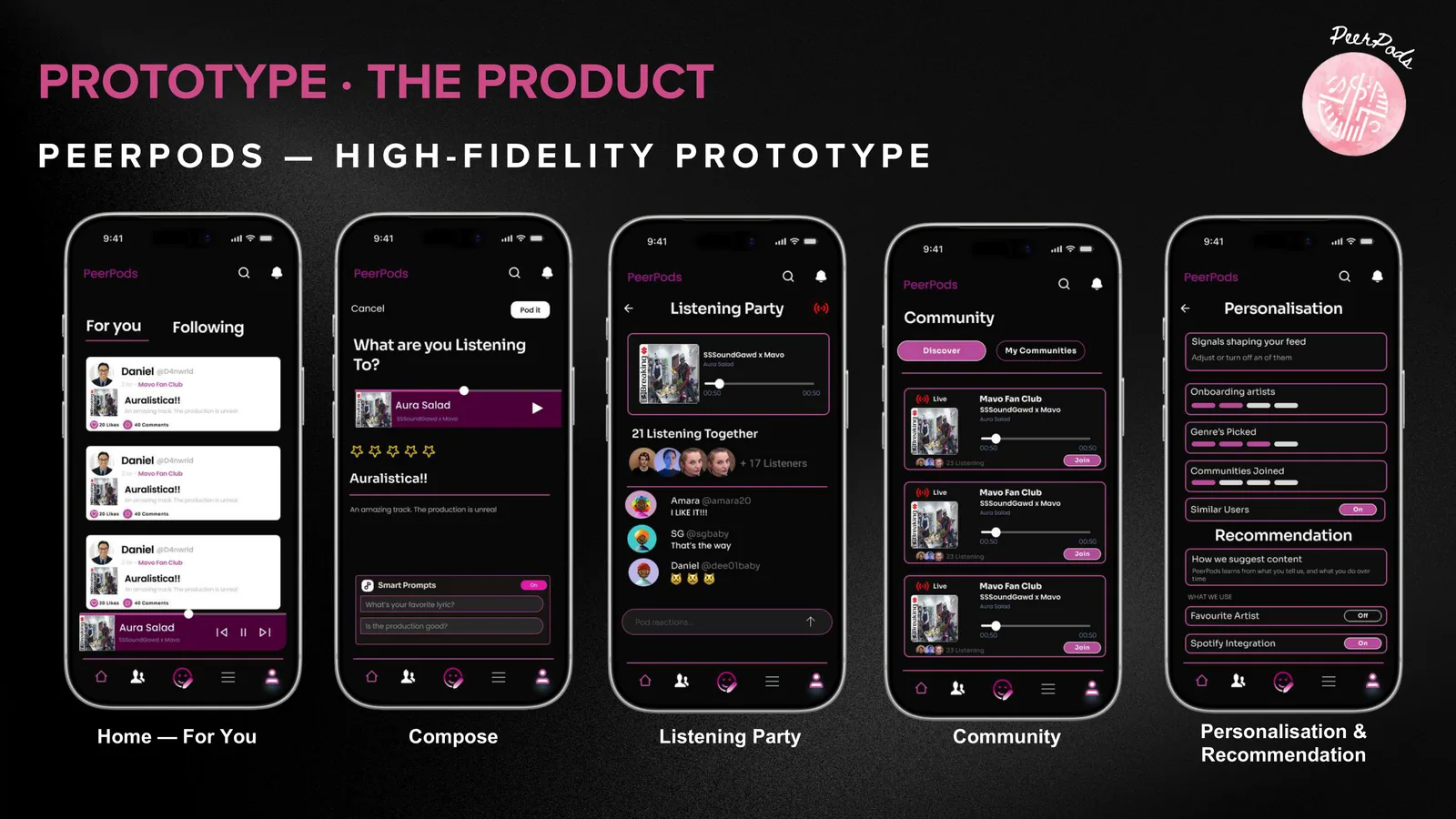
Five high-fidelity Figma screens: Home with Smart Prompts drawer, Compose with adaptive prompts, a Listening Party with synced playback and chat, Community discovery, and the Personalisation settings panel.
 15
The intelligence, made visible
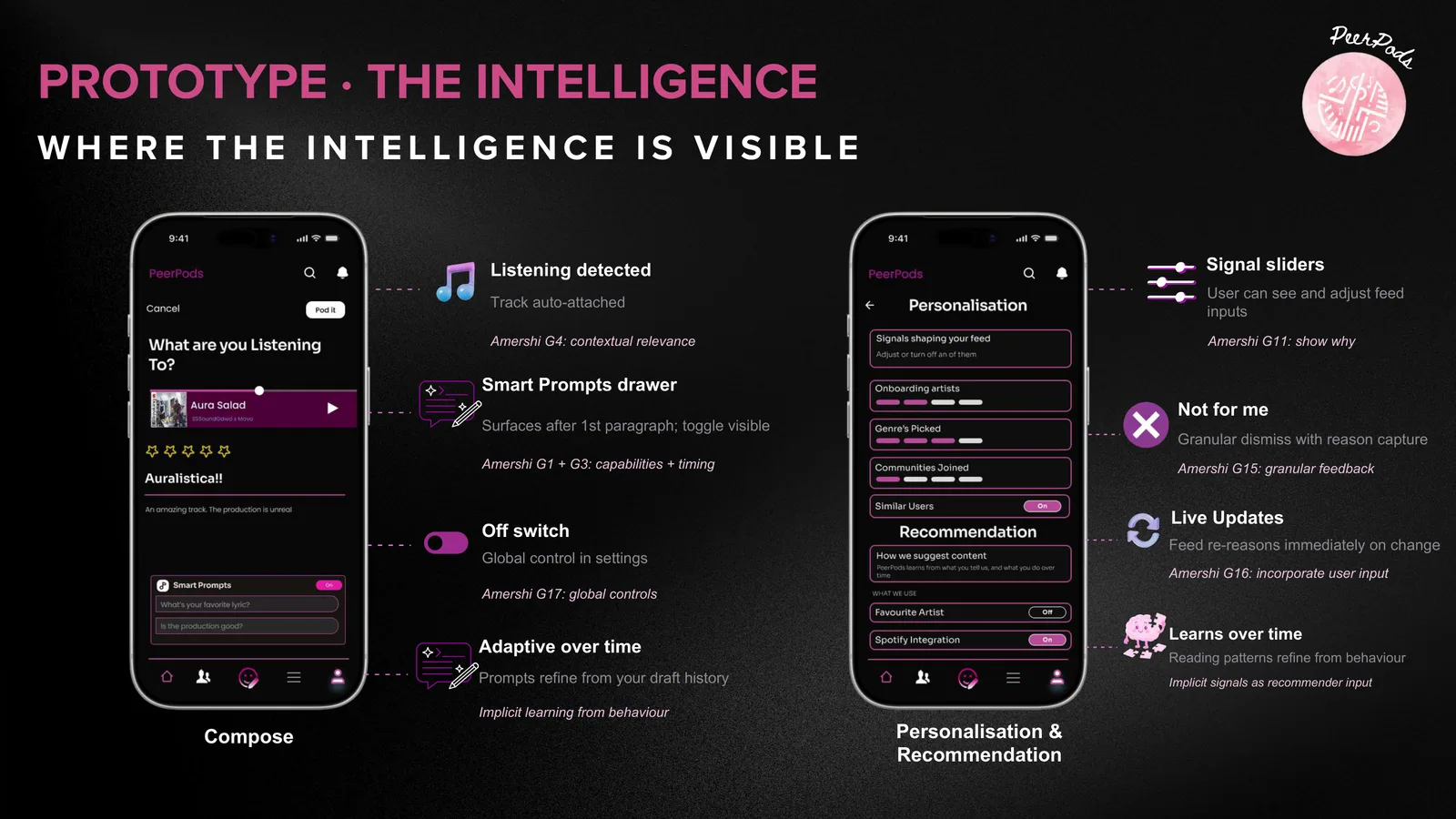
Track auto-attached when listening is detected; Smart Prompts after the first paragraph with a toggle; a global off switch; signal sliders showing what shapes the feed; "Not for me" with reason capture; and live feed re-reasoning.
 16
Evaluation: think-aloud
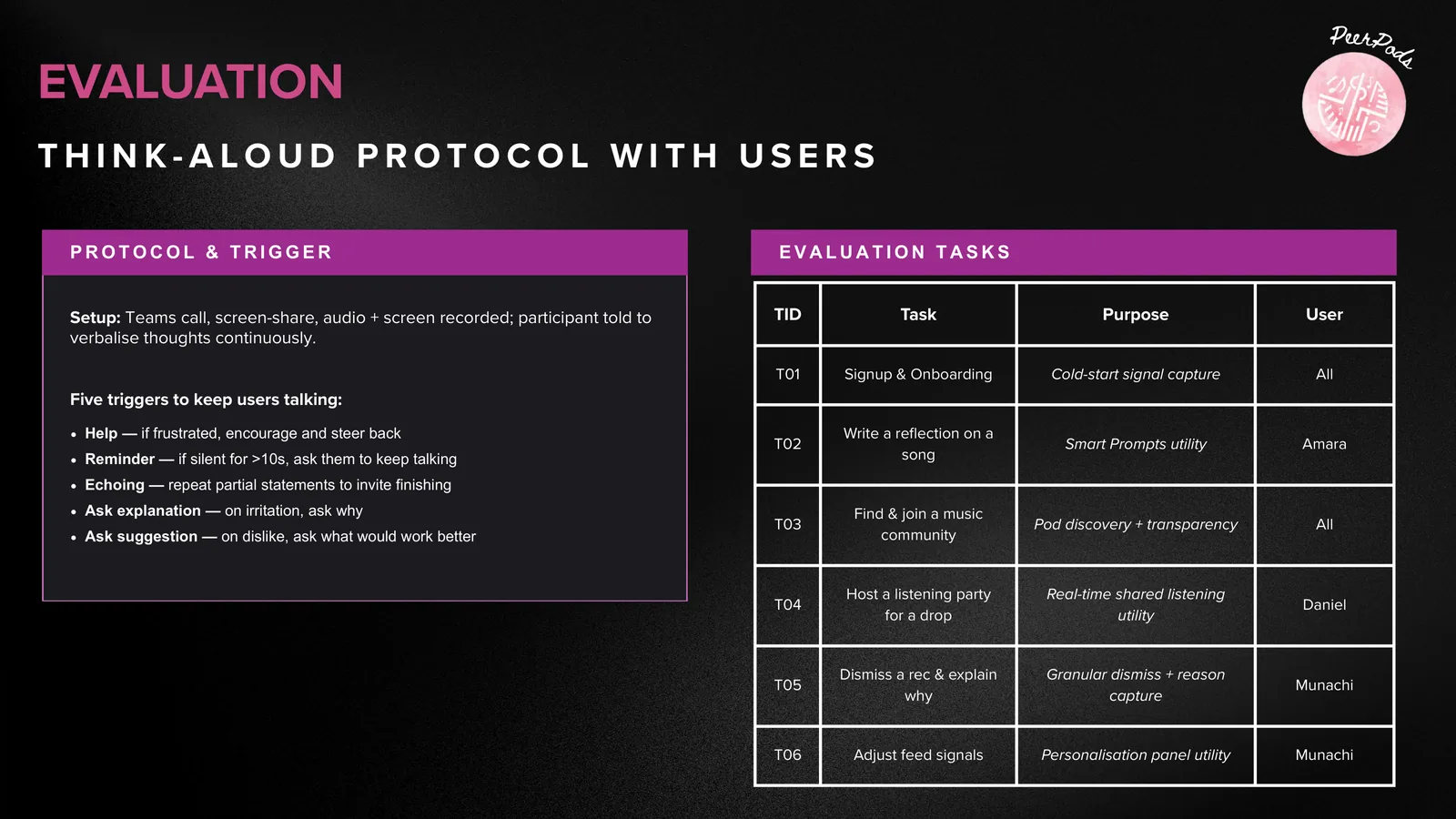
Think-aloud sessions over Teams with 3 participants mapped to the personas. Six tasks: onboarding, writing a reflection, joining a community, hosting a listening party, dismissing a rec and adjusting feed signals.
 17
Findings
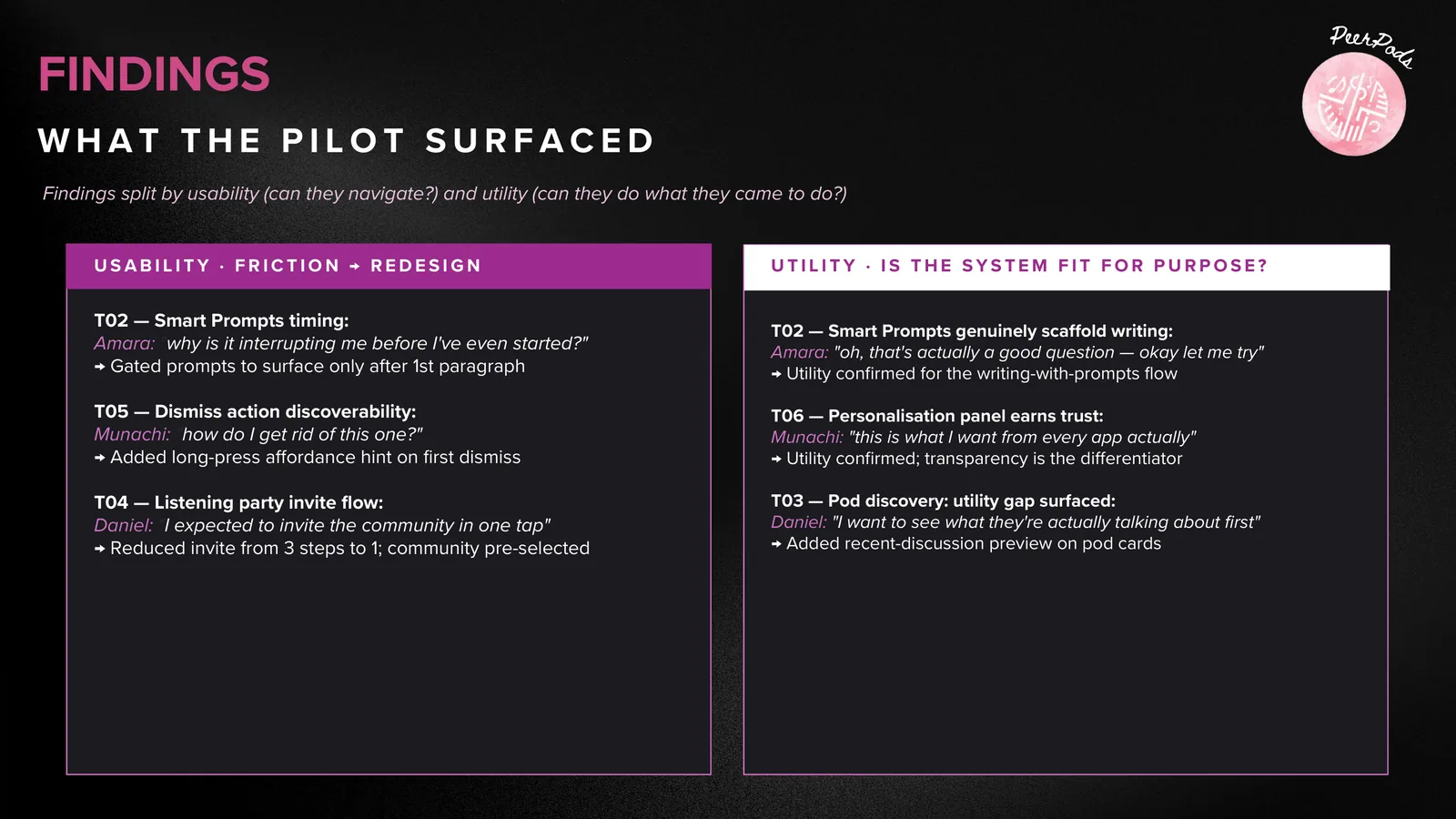
Smart Prompts were moved to after the first paragraph ("why is it interrupting me before I've even started?"), a long-press hint was added, and the listening-party invite went from 3 steps to 1. The personalisation panel earned trust.
 18
Reflection
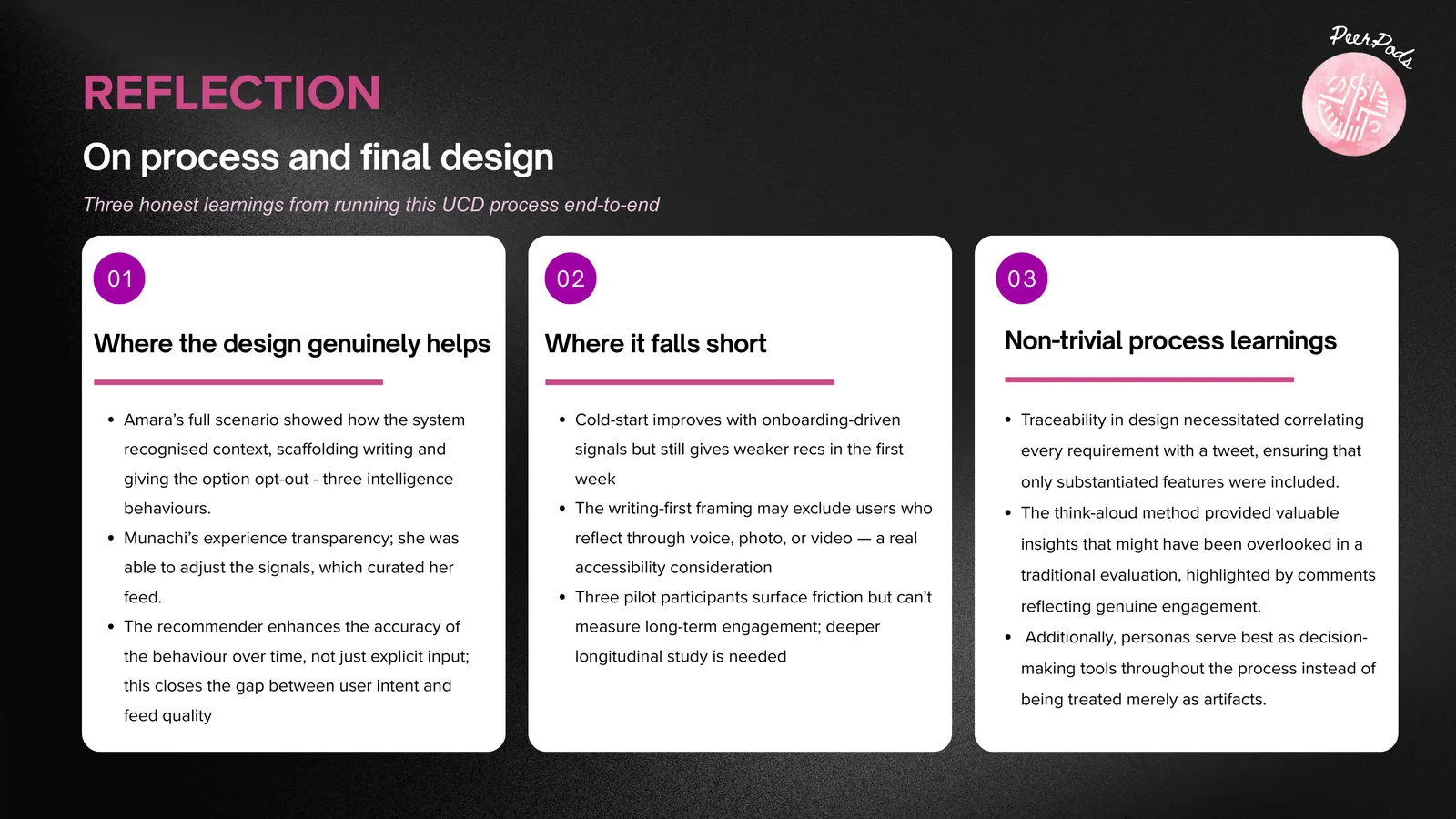
Strong on context recognition, scaffolded writing and transparent control. Weak on cold-start recommendations in week 1, and writing-first excludes voice or photo reflectors. Three participants can't measure long-term engagement. Traceability forced every feature to be evidence-backed.